
Why eDisclosure sits at the centre of UK commercial litigation
Nearly every civil claim brought against a corporation in England and Wales now turns, at least in part, on electronic evidence. Emails, Teams and Slack messages, contract management systems, mobile phones, cloud drives and finance platforms all carry the record of what was said, agreed and done. The formal process by which that record is produced to the other side and to the court is called eDisclosure, and it is governed by rules that have tightened significantly over the last decade.
The purpose of this guide is to set out, in one place, what eDisclosure in the UK involves, what the courts expect from a corporate party, and how E-Discovery UK runs an exercise that stands up to scrutiny. It draws on the same practice we apply to intellectual property claims, breach of contract disputes, competition matters and regulatory investigations across the Business and Property Courts.
The rules that shape eDisclosure in the UK
Two regimes matter. For most civil claims outside the Business and Property Courts, CPR Part 31 continues to govern standard disclosure and specific disclosure. Inside the Business and Property Courts, which is where most substantial corporate disputes are heard, Practice Direction 57AD applies. PD 57AD replaced the Disclosure Pilot in 2022 and reshaped the way English courts approach large-scale eDisclosure.
PD 57AD imposes a duty on the parties to preserve documents from the moment litigation is reasonably contemplated, to cooperate on the scope of disclosure, and to complete a joint Disclosure Review Document. The DRD forces the parties to agree the issues for disclosure, identify data sources and custodians, and select one of five Extended Disclosure Models, ranging from Model A, known adverse documents only, to Model E, wide search-based disclosure reserved for exceptional cases. Model D, search-based disclosure on agreed issues, is the workhorse for most commercial disputes.
The court expects the DRD to be evidence-led and proportionate. Broad Model D requests will be pushed back on if the party cannot explain why they are needed, what sources they cover, and how the search is designed. This is where the eDisclosure provider does its most important legal-technical work.
How E-Discovery UK handles eDisclosure
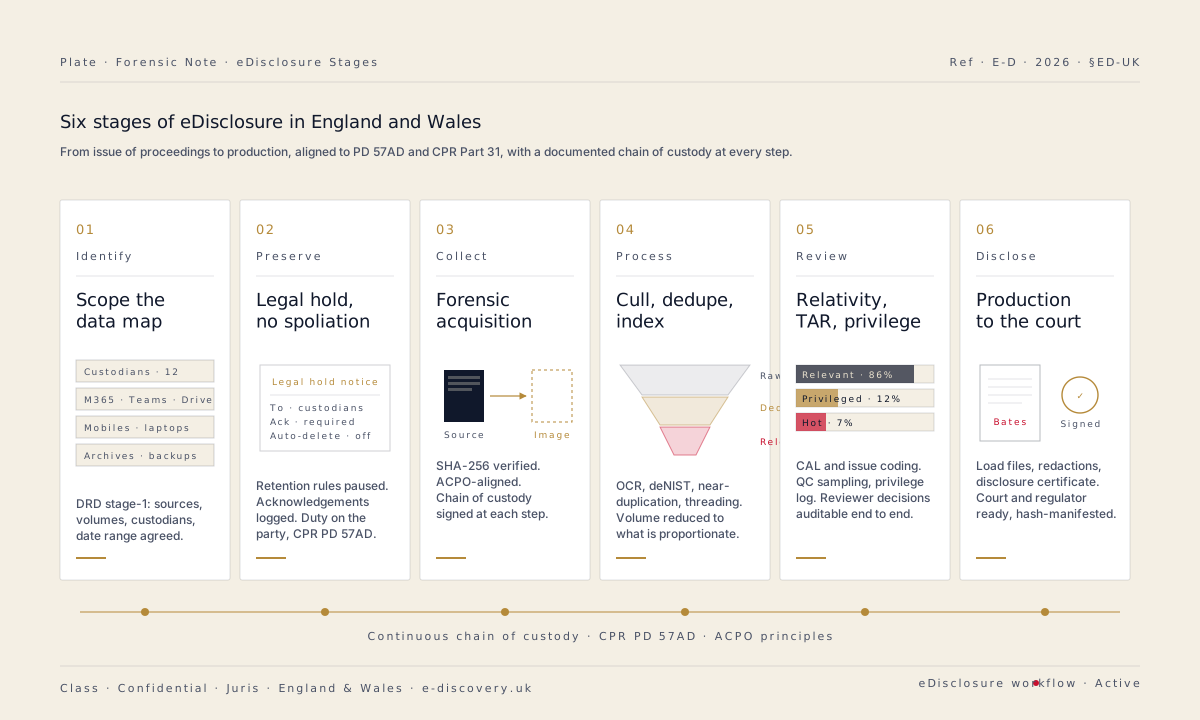
We approach every mandate as a forensic exercise, not a data processing one. The workflow is the same six-stage model shown on the plate above, and each stage is documented so that any decision, from a keyword to a de-duplication threshold, can be justified to the other side and to the court.
1. Identify: mapping the data estate
Before any data moves, we sit with the legal team and the client's IT function to build a data map. That means custodians, roles, dates, and the systems each custodian actually uses, corporate email, M365, Teams, SharePoint, Google Workspace, mobile devices, corporate messaging, personal devices used for work, and legacy archives. The output is the technical evidence that supports the DRD stage-1 agreement.
2. Preserve: legal hold that will not embarrass the party
We help draft and issue legal hold notices, suspend auto-deletion, and confirm acknowledgements. Preservation obligations bite from the moment litigation is reasonably contemplated, well before proceedings issue, and failure to preserve is one of the fastest ways to lose credibility with a judge. The preservation record we produce is signed, dated and defensible.
3. Collect: forensic acquisition, not IT copies
Collection is where corners are most often cut and most often regretted. We take forensic images of the source data, verify each image with SHA-256 hashes, and record every action in a chain-of-custody log. Mobile phones are extracted with Cellebrite, laptops with EnCase or Magnet AXIOM, and cloud data is captured through vendor-native forensic connectors. Everything follows ACPO principles.
4. Process: proportionate reduction of volume
Processing turns a raw forensic image into reviewable data. We de-duplicate at family level, remove system files, run OCR on scanned material, thread email conversations, and cull by date range and custodian. On a well-run matter this often reduces the review population by more than eighty per cent before a single reviewer looks at a document, which is what makes proportionate disclosure achievable.
5. Review: Relativity, TAR and privilege discipline
Review takes place in a Relativity workspace, hosted in the UK. For anything above a few hundred thousand documents we run Continuous Active Learning to prioritise likely relevant material, with the TAR protocol agreed in the DRD. Privilege is handled by a dedicated legally qualified team, with a privilege log built as review progresses. Every reviewer decision is auditable and every workflow change is versioned.
6. Disclose: production that meets the order
Production is the last stage where a well-run exercise can still go wrong. We produce load files that match the format ordered by the court, apply redactions cleanly, generate Bates numbering and produce a disclosure certificate that is signed by an appropriately senior officer of the corporate party. Every production is hash-manifested so that the receiving party gets exactly what was disclosed.
What the UK courts want, and how we deliver it
Judges in the Business and Property Courts have made it clear, in a line of cases from Pyrrho onward, what they expect from eDisclosure. Four themes recur.
Proportionality. The cost of disclosure should bear a sensible relationship to the value and complexity of the dispute. Wide keyword lists that hit millions of documents will be refused. We build search designs that are defensible on their own terms, with hit reports and sampling to support them.
Cooperation. PD 57AD is emphatic that the parties must cooperate on disclosure. The DRD is not a form-filling exercise, it is a negotiation. We support instructing solicitors in that negotiation with the technical evidence they need to hold their ground.
Transparency. The court wants to know how a party got from a data estate to a production. That means documented decisions on custodians, sources, date ranges, keywords, TAR protocols, sampling and privilege review. Our documentation pack is designed to answer those questions in advance.
Integrity. The court wants to be able to trust the underlying data. Hash verification, chain of custody and reproducible processing are non-negotiable. This is where a forensic-led eDiscovery provider differs from a general document-review vendor.
How disclosure changes with the dispute
Intellectual property claims
IP disputes, whether patent, trade secrets or copyright, usually turn on a narrow set of documents held by a small group of custodians, sitting alongside code repositories, engineering wikis and design files. eDisclosure in an IP claim leans heavily on early forensic collection of source code control systems, laptops of departing engineers, and cloud storage. Privilege review is often lighter, but confidentiality clubs and inspection protocols become central.
Breach of contract
Contract disputes generate email-heavy datasets across sales, procurement, finance and legal. The key documents are usually contract drafts, negotiation correspondence and internal decision-making around performance. Search design here focuses on named counterparties, project code names and specific dates in the contract lifecycle. Model D disclosure on issues is standard.
Wider corporate and commercial disputes
Shareholder disputes, warranty claims, competition follow-on actions and fraud claims combine large document populations with real complexity. TAR earns its keep on these matters. So does a disciplined approach to privilege, because these datasets typically contain heavy volumes of communication with external counsel and advisers.
Instructing E-Discovery UK
We accept instructions directly from in-house legal teams and, more often, through instructing solicitors. First contact usually leads to a scoping call in which we agree custodians, systems and a working timetable that fits the court's expectations. Where matters are already active, we can attend the first Case Management Conference alongside the legal team to speak to the technical elements of the DRD.
Every mandate is priced on a transparent per-GB, per-custodian or fixed-scope basis, agreed in writing before work starts. Data stays in the UK, hosted on ISO 27001 aligned infrastructure, and can be produced or destroyed at the end of the matter on instruction.
Frequently asked questions
What is eDisclosure in the UK?
eDisclosure is the process by which parties to civil proceedings in England and Wales identify, preserve, collect, review and produce electronically stored information that is relevant to the issues in the case. It is governed by CPR Part 31 in most civil claims and, for the Business and Property Courts, by Practice Direction 57AD, which sets out the Disclosure Review Document and the menu of Extended Disclosure Models A to E.
Is eDisclosure the same as eDiscovery?
In practical terms, yes. eDiscovery is the term used in the United States and internationally, and e-discovery is often used in commercial writing in the UK. eDisclosure is the term the English courts use for the disclosure obligation in civil litigation. The underlying workflow, identify, preserve, collect, process, review and produce, is the same. On this site we use both terms because clients search for both.
What does PD 57AD require of a corporate defendant?
PD 57AD requires the parties to cooperate on disclosure, complete a joint Disclosure Review Document, agree the issues for disclosure, and select an appropriate Extended Disclosure Model. It also imposes ongoing duties to preserve documents, to disclose known adverse documents, and to certify compliance. Corporate defendants must issue legal holds promptly and be able to demonstrate the reasonableness of their searches.
How long does eDisclosure take in a typical commercial case?
A well-scoped mid-size commercial disclosure exercise, say 200,000 to 1 million documents, usually takes eight to sixteen weeks from legal hold to first production. IP disputes with source code review, or investigations that touch mobile devices and collaboration platforms, take longer because more careful forensic work is needed at the front end. Realistic timetables are set with the court at the Case Management Conference.
How is privileged material protected during disclosure?
Privilege is handled at the review stage. Documents are screened with keyword lists of law firms, counsel and in-house lawyers, then reviewed by lawyers who apply legal advice or litigation privilege coding. Privileged documents are logged in a privilege log, redacted where appropriate, and withheld from production. Inadvertent disclosure is addressed under the CPR and the Bar Standards Board rules.
What is Technology Assisted Review and will the UK courts accept it?
TAR uses supervised machine learning to prioritise or classify documents by relevance. Continuous Active Learning, the most widely used approach, is expressly permitted under PD 57AD provided the parties agree its use in the Disclosure Review Document. English courts have approved TAR since Pyrrho Investments v MWB Property in 2016, and it is now standard practice on any matter with more than a few hundred thousand documents.
Can eDisclosure evidence be used in international proceedings?
Yes. A defensible chain of custody, hash-verified images and a documented processing history mean that data collected for an English disclosure exercise can be reused in parallel arbitration, regulatory investigations or foreign proceedings, subject to data protection and cross-border transfer rules. We plan collections with reuse in mind wherever a matter is likely to span jurisdictions.
Discuss your disclosure exercise in confidence
Speak to a senior member of the E-Discovery UK team about scoping, PD 57AD compliance, or an active matter.
Request a confidential consultation