§ Knowledge Centre

Practice notes from working practitioners.

Short, opinionated pieces on the questions that come up most often from counsel and in-house teams. No vendor marketing, no 'thought leadership', just what we tell clients.

Ref · E-D · 2026 · §KNOClass · ConfidentialJuris · England & WalesStatus · Active
Open antique book under a brass magnifying glass on a dark felt surface.Plate · Knowledge
Plate · Plate · KnowledgeWhat we tell counsel, written down.

Finds guides by subject category and title, and the questions Ask The Library already answers.

Topics
§ Flagship guide · 2026 edition

The Complete Guide to eDiscovery and eDisclosure

From the first preservation notice to the final trial bundle: a UK-first handbook for litigation teams, with a working comparison to United States practice. Seventy-four pages, thirty sections, five parts, written by the digital forensic and eDiscovery team at Computer Forensics Lab and stated as at 20 September 2026.
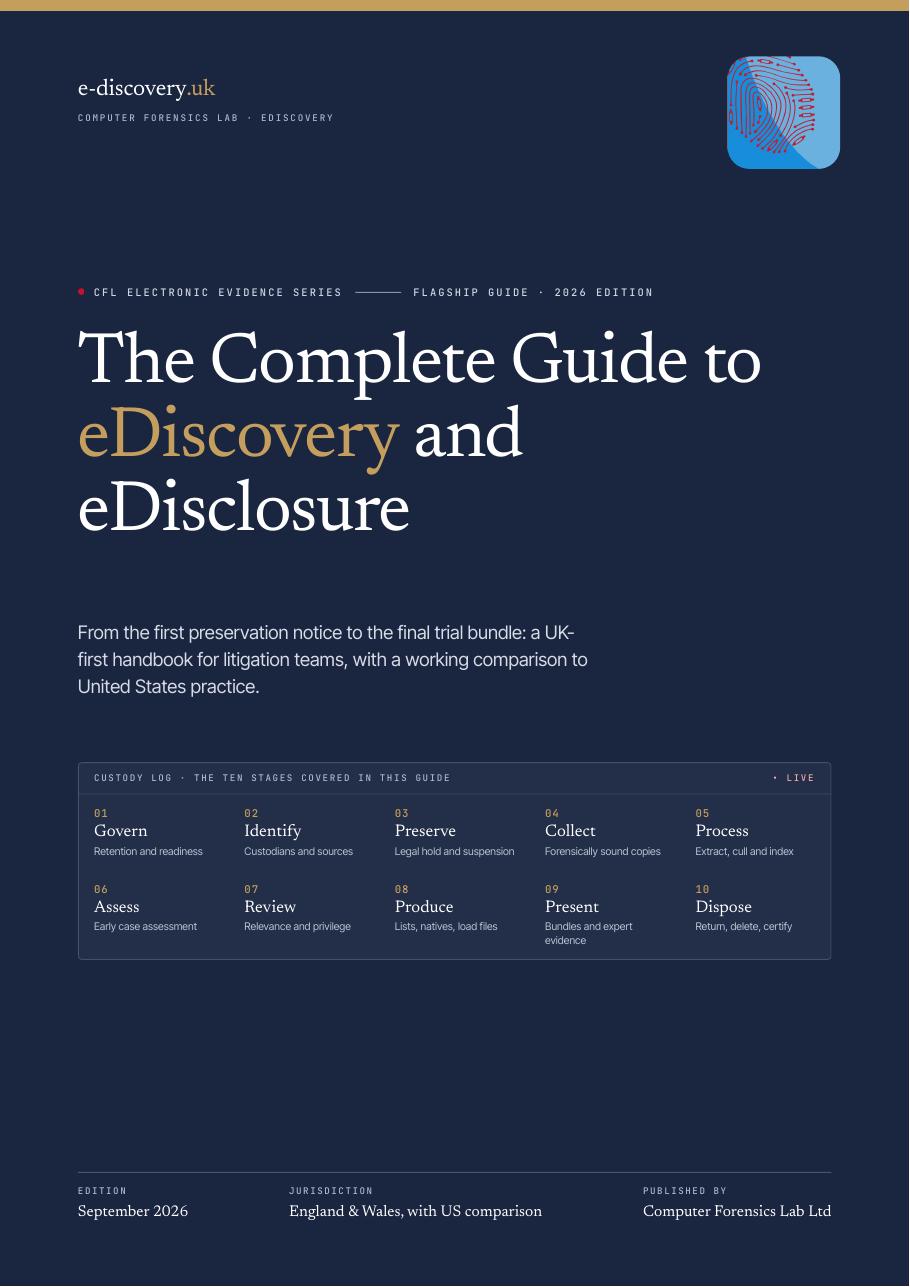
Cover of The Complete Guide to eDiscovery and eDisclosure
  1. 01 · Foundations: rules and vocabulary
  2. 02 · England and Wales v the United States
  3. 03 · Governance, readiness and legal holds
  4. 04 · Sources, custodians and collection
  5. 05 · Processing and early case assessment
  6. 06 · Search, review and quality control
  7. 07 · Technology assisted review and AI
  8. 08 · Privilege, redaction and production
  9. 09 · Non-parties, cross-border and data protection
  10. 10 · Toolkit: checklists, wording and glossary

Each section explains the problem in plain English, says why it matters legally, and sets out what a lawyer should actually do next. Part Five collects the working tools: worked examples, forty questions to ask, suggested wording for preservation advice and hold notices, a master checklist and a fifty term glossary.


§ PDF library

Brochures and downloadable guides

Every PDF we publish, in one place: our digital forensics services brochure, UK support for US litigation teams, and each new guide as it is released.

Open the PDF library
§ Practical digest

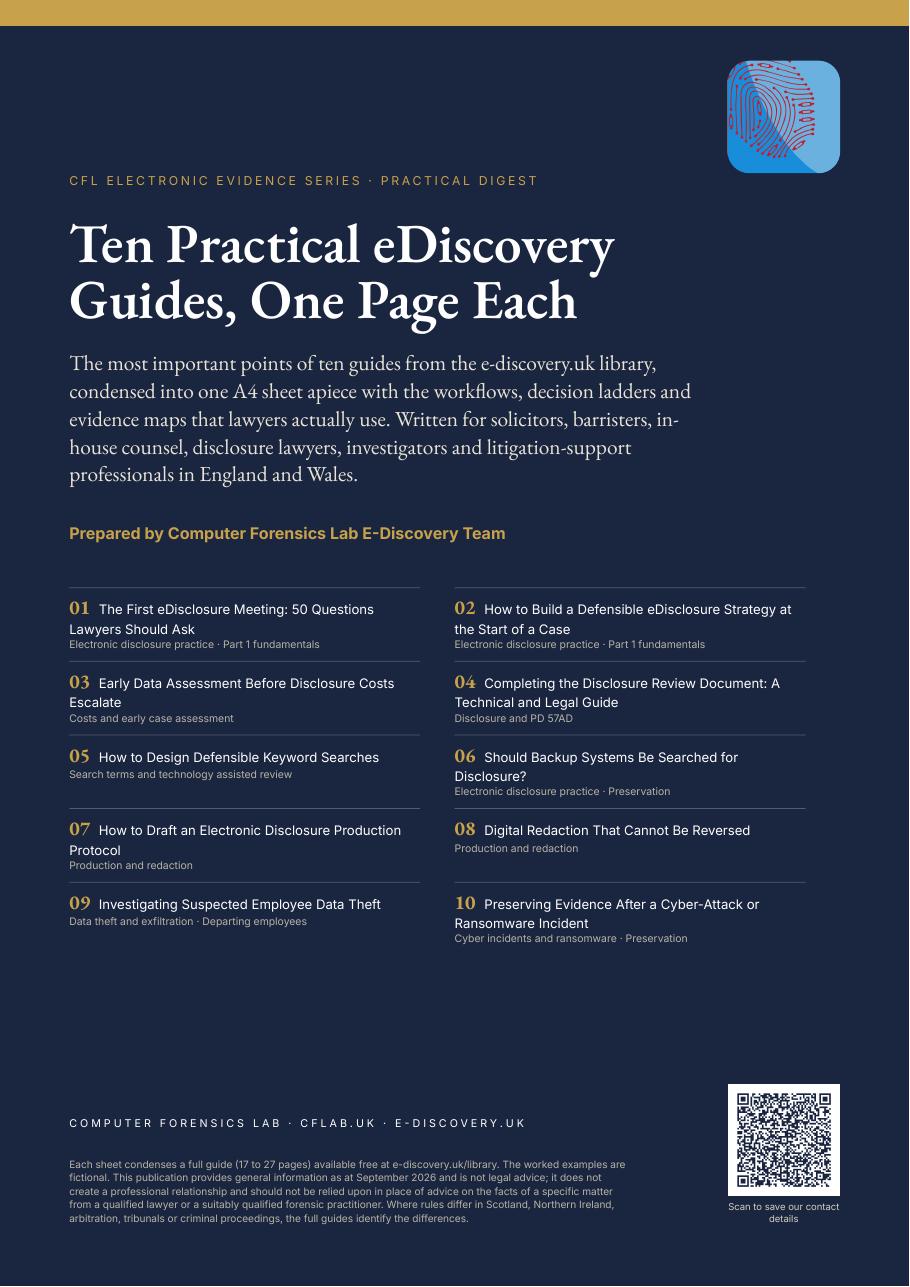
Ten Practical eDiscovery Guides, One Page Each

The most important points of ten guides from the e-discovery.uk library, condensed into one A4 sheet apiece with the workflows, decision ladders and evidence maps that lawyers actually use. Written for solicitors, barristers, in-house counsel, disclosure lawyers, investigators and litigation-support professionals in England and Wales.

Your browser cannot display the PDF here. Open the digest in a new tab.

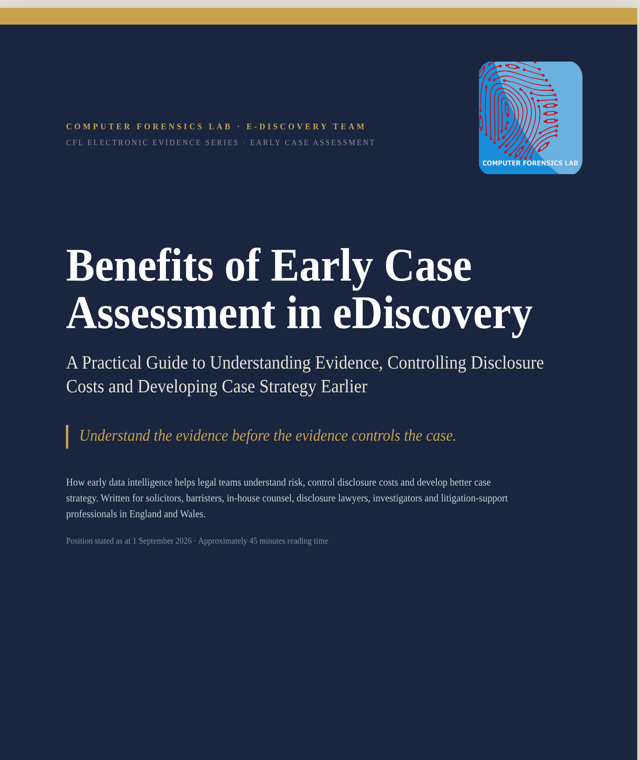
Cover of the guide, Benefits of Early Case Assessment in eDiscovery
§ Featured guide

Benefits of Early Case Assessment in eDiscovery

How early case assessment narrows the data set before review, what it costs to skip it, and the questions to settle with the other side at the first case management conference.

Read the guide
Featured practice note · 2026

What Law Firms Need to Know About RSMF and Relativity.

A plain-language guide to RSMF (Relativity Short Message Format) and how short-message data such as WhatsApp, SMS and Teams chats is prepared for Relativity review in UK litigation.

8 min · Practice noteRead in full →
Fraud

Following the Digital Trail in Procurement Fraud

Uncover procurement fraud through digital forensics. This guide details identification, collection, processing, and analysis techniques for UK investigations.

8 minRead →
Regulatory

Using E-Discovery to Investigate Employee Policy Breaches

This practice note details how e-discovery principles and techniques are applied to investigate employee policy breaches, focusing on UK legal and operational considerations.

13 minRead →
Bribery

E-Discovery for Third-Party Agent and Intermediary Investigations

Guidance on leveraging e-discovery for third-party agent and intermediary investigations, focusing on UK Bribery Act compliance.

6 minRead →
Competition

E-Discovery Strategies for Cartel Investigations

Strategies for e-discovery in UK cartel investigations, covering data identification, preservation, collection, review, and disclosure processes.

10 minRead →
Employment

Investigating Whistleblowing Allegations With E-Discovery

Guidance on using e-discovery techniques for investigating whistleblowing allegations, focusing on UK legal and regulatory frameworks.

10 minRead →
Insider threat

Digital Evidence of Employee Sabotage

Guidance on identifying, preserving, collecting, and analysing digital evidence in UK employee sabotage investigations, focusing on forensic techniques.

10 minRead →
M&A

Finding Hidden Corporate Risks Before an Acquisition

Pre-acquisition due diligence requires robust eDiscovery to uncover hidden corporate risks. This guide details effective strategies for UK M&A practitioners.

12 minRead →
IP and trade secrets

Digital Evidence of Trade Secret Theft

Understand digital evidence in trade secret theft cases. Learn about identification, preservation, collection, and analysis of electronic data to prove exfiltration.

8 minRead →
Fraud

Using Digital Forensics and E-Discovery Together in Fraud Investigations

This practice note outlines how digital forensics and e-discovery methodologies are combined effectively in UK fraud investigations.

10 minRead →
Regulatory

E-Discovery, GDPR and Data Protection: What Organisations Need to Know

This practice note examines the critical interplay between e-discovery obligations and data protection requirements under UK GDPR for organisations operating in the UK.

10 minRead →
Bribery

Finding Evidence of Kickbacks Through Email and Messaging Review

This note provides practical guidance on identifying evidence of kickbacks in electronic communications during an e-discovery review process.

10 minRead →
Competition

Using Email and Messaging Evidence to Investigate Price Fixing

This practice note provides specific guidance on utilising email and messaging evidence to investigate price fixing, aligning with UK e-discovery standards.

13 minRead →
Employment

Digital Evidence in Workplace Harassment Investigations

Guidance on identifying, preserving, collecting, and reviewing digital evidence in UK workplace harassment investigations for legal professionals.

10 minRead →
Insider threat

How to Investigate a Suspected Malicious Employee

This note provides practical, UK-centric guidance for investigating suspected malicious employee activity, from initial preservation to analysis and reporting.

10 minRead →
M&A

Using E-Discovery for Investigative M&A Due Diligence

This practice note outlines how e-discovery techniques enhance investigative mergers and acquisitions due diligence processes in the UK, identifying hidden risks.

8 minRead →
IP and trade secrets

How to Investigate an Employee Suspected of Stealing Company Data

Guidance on investigating employee data theft. Covers legal basis, practical steps, forensic collection, and eDiscovery implications for UK practitioners.

8 minRead →
Fraud

How Email Evidence Can Reveal Internal Fraud

This practice note outlines how email evidence can be instrumental in uncovering and proving internal fraud, detailing key forensic techniques and e-discovery workflows.

10 minRead →
Regulatory

E-Discovery and Regulatory Investigations in the UK

Navigate e-discovery in UK regulatory investigations. Understand data preservation, collection, and disclosure requirements from regulators like the FCA and CMA.

10 minRead →
Bribery

Using Digital Evidence in UK Bribery Act Investigations

Guidance on using digital evidence in UK Bribery Act investigations, covering identification, preservation, collection, and analysis for legal and regulatory compliance.

13 minRead →
Competition

How E-Discovery Supports CMA Competition Investigations

E-Discovery is crucial for CMA competition investigations, aiding in information requests, dawn raids, and complex regulatory enquiries. Understand its application.

10 minRead →
Employment

E-Discovery in UK Employment Tribunal Disputes

Navigate e-discovery in UK Employment Tribunal disputes effectively. This guide covers essential steps from identification to disclosure, focusing on UK legal frameworks.

10 minRead →
Insider threat

E-Discovery for Insider Threat Investigations

Understand how e-discovery principles and workflows apply to insider threat investigations, including preservation, collection, processing, and review of digital evidence. This note offers practical steps for UK practitioners.

12 minRead →
M&A

How E-Discovery Supports Mergers and Acquisitions

Explore how e-discovery processes are critical for M&A transactions, supporting due diligence, competition reviews, and post-acquisition disputes.

13 minRead →
IP and trade secrets

E-Discovery for Intellectual Property and Trade Secret Disputes

Navigate e-discovery challenges in intellectual property and trade secret disputes. Understand unique data sources and forensic requirements.

10 minRead →
Fraud

E-Discovery for Corporate Fraud Investigations

Practical guidance on applying e-discovery principles and workflows to corporate fraud investigations, covering key stages and considerations.

8 minRead →
Regulatory

How E-Discovery Supports Corporate Compliance Investigations

E-discovery plays a crucial role in corporate compliance investigations by efficiently managing and analysing electronic information for evidence.

6 minRead →
Bribery

How E-Discovery Supports Bribery and Corruption Investigations

This note details how e-discovery supports bribery and corruption investigations, covering common scenarios and workflow integration.

6 minRead →
Competition

E-Discovery in UK Competition and Anti-Trust Investigations

Practical guidance on e-discovery in UK competition and anti-trust investigations, covering regulatory requests, dawn raids, and damages claims.

10 minRead →
§ Guide library

eDiscovery guide topics

All 163 guides, grouped by subject: disclosure practice, forensic collection, deleted data, cloud and mobile evidence, chain of custody and more.

Browse guide topics
§ Recent notes
Forensics

Common Problems in WhatsApp eDiscovery

WhatsApp evidence is powerful but tricky. This guide covers the common problems, disappearing messages, screenshots, backups and group context, and how to handle them.

6 minRead →
Forensics

From Mobile Extraction to Relativity Review

A step-by-step look at how data travels from a forensic mobile extraction through processing and RSMF conversion into a Relativity review.

7 minRead →
Disclosure

How Forensic Collection Supports Disclosure

Disclosure obligations require reasonable, proportionate searches and reliable data. This guide explains how forensic collection underpins a sound disclosure exercise.

7 minRead →
Disclosure

How to Scope an eDiscovery Collection Exercise

Scoping decides custodians, data sources and date ranges before collection begins. This guide explains how to scope an eDiscovery exercise proportionately.

6 minRead →
Forensics

Mobile Phone Chat Evidence in UK Litigation

How mobile phone chat evidence, WhatsApp, SMS, iMessage and more, is collected, processed and reviewed for UK litigation and investigations.

7 minRead →
Review

Preparing Large Data Sets for Legal Review

High-volume eDiscovery requires disciplined processing, filtering and organisation. This guide explains how large data sets are prepared so review stays proportionate and reliable.

7 minRead →
Investigations

Preserving Chain of Custody in Corporate Investigations

Chain of custody records who handled evidence, when and how. This guide explains why it matters in corporate investigations and how it is maintained.

6 minRead →
Investigations

Slack and Teams Data in Corporate Investigations

Collaboration platforms like Slack and Microsoft Teams hold critical evidence in corporate investigations. This guide covers how that data is collected and reviewed defensibly.

7 minRead →
Practice

What Lawyers Should Ask Before Starting a Document Review Project

A practical checklist of questions to ask before a document review project begins, covering data sources, processing, defensibility and deliverables.

5 minRead →
Practice

Why Metadata Matters in Document Review

Metadata can establish who created a document, when, and what happened to it. This guide explains why metadata is central to defensible document review and investigation strategy.

6 minRead →
Review

Technology-Assisted Review and AI in UK eDiscovery

How technology-assisted review and AI ranking tools can make large document review proportionate and defensible in UK litigation.

7 minRead →
Practice

GDPR, DSAR and eDiscovery

How to balance disclosure obligations and data subject rights under GDPR when handling personal data in eDiscovery.

6 minRead →
Practice

Relativity vs Reveal: A Buyer's Guide to Data Scoping, ECA, Scale and Active Hosting

A practical comparison of Relativity and Reveal across data scoping, early case assessment, scale and active hosting, with published performance figures and a clear verdict on which platform suits which matter.

6 minRead →

Applying any of this to a live matter?

Request a confidential consultation
§ Ask a London eDiscovery specialist

Comparing platforms, or costing a disclosure exercise?

Tell us what you are weighing up, an eDiscovery platform comparison, hosting costs, an early case assessment, or a looming disclosure deadline. A senior practitioner in our London office will reply the same working day with a straight answer, and we will send any guide that helps.

  • Independent, no vendor commission
  • Indicative costs before you commit
  • Attendance across London and the City at short notice

Goes to info@e-discovery.uk · no third-party trackers

Instruct the practice

Bring us in early. Defensibility is built, not retrofitted.

Whether you are responding to a regulator, preparing for disclosure, or scoping an internal investigation, start the chain of custody with a short, confidential conversation.

WhatsApp