
§ 01
UK forensic collection
On-site or remote collection across the UK, hash-verified, with a signed collection statement and full chain of custody to NPCC guidelines.
For US litigation teams with custodians, servers or witnesses in the United Kingdom. We collect forensically in the UK, minimise and review in the UK, transfer under a lawful mechanism, and produce to your ESI protocol in a format your vendor can load. Terminology on this page is given in both vocabularies: UK eDisclosure, US eDiscovery.
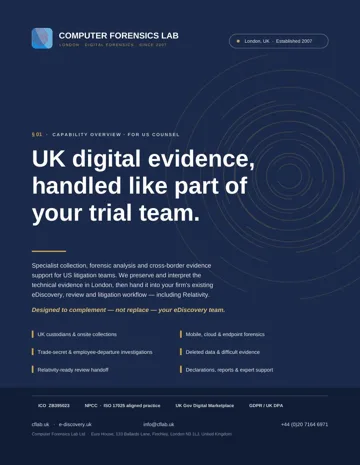 Plate · Cross-border
US litigators, in-house counsel and litigation support managers who need defensible evidence from the United Kingdom without importing a compliance problem.
Custodians, devices or servers located in England, Wales, Scotland or Northern Ireland.
A UK collection partner who delivers in your load-file specification.
Cross-border investigations touching UK subsidiaries or UK employees.
Hague letters of request and evidence for US proceedings located in England.
Nearly every problem we are asked to repair began with a collection that ignored UK constraints.
A UK employee zipping their own mailbox destroys metadata, misses deleted and archived content, and is difficult to defend if authenticity is challenged.
Shipping a full forensic image to a US vendor makes the UK GDPR transfer analysis far harder than it needed to be. Filter first, in the UK.
UK employment and data protection law constrains what can be taken from a personal phone. Consent has to be informed and the scope has to be narrow and recorded.
An ESI protocol demanding metadata fields that a UK on-premises Exchange or a Teams export never carried creates a production dispute months later.
A single UK counterparty from preservation notice to produced volume.
On-site or remote collection across the UK, hash-verified, with a signed collection statement and full chain of custody to NPCC guidelines.
De-duplication, date and custodian filtering, search terms, threading and near-duplicate grouping applied before any transfer, with the reduction documented.
Transfers under the IDTA or the UK Addendum with a transfer risk assessment, or under the Data Privacy Framework where the recipient is certified, with encryption in transit and at rest.
TIFF or PDF with searchable text, natives for structured data, Bates or control numbering, agreed metadata fields, privilege log support and a load file your vendor can ingest.
Witness statements and expert testimony on methodology, authenticity and chain of custody, given remotely for US proceedings or in person in the UK.
Practical support for Hague Evidence Convention requests executed in England and Wales, including realistic scoping before the request is drafted.
Both work. These are the differences that show up on a matter.
Processing and hosting in the UK by default, so the transfer question is answered once, deliberately, with a minimised set.
The same practice that runs the review also does the imaging, so authenticity questions are answered by the person who did the work.
The practitioner who scopes the collection supervises it. There is no account layer between you and the examiner.
For petabyte-scale second requests with round-the-clock global review capacity, a large global vendor is the right answer, and we will say so.
Cited so your team can check the position rather than take ours on trust.
Every engagement produces the same documented set, whatever the size of the matter.
What was collected, from whom, by what method, when, and the hash values that prove it has not changed.
An unbroken log from acquisition to production, exhibitable if authenticity is put in issue.
The filters applied, the reduction achieved, and the mechanism relied on for the transfer.
Images, natives, text, load file and privilege log in your agreed specification, delivered on an encrypted channel.
Every source we collect from, and how each is handled.
Disclosure, production, DRD, ESI protocol: the terms translated.
Credentials, court experience and the basis of expert testimony.
How UK work is priced, in units a US team can compare.
Whether you are responding to a regulator, preparing for disclosure, or scoping an internal investigation, start the chain of custody with a short, confidential conversation.